
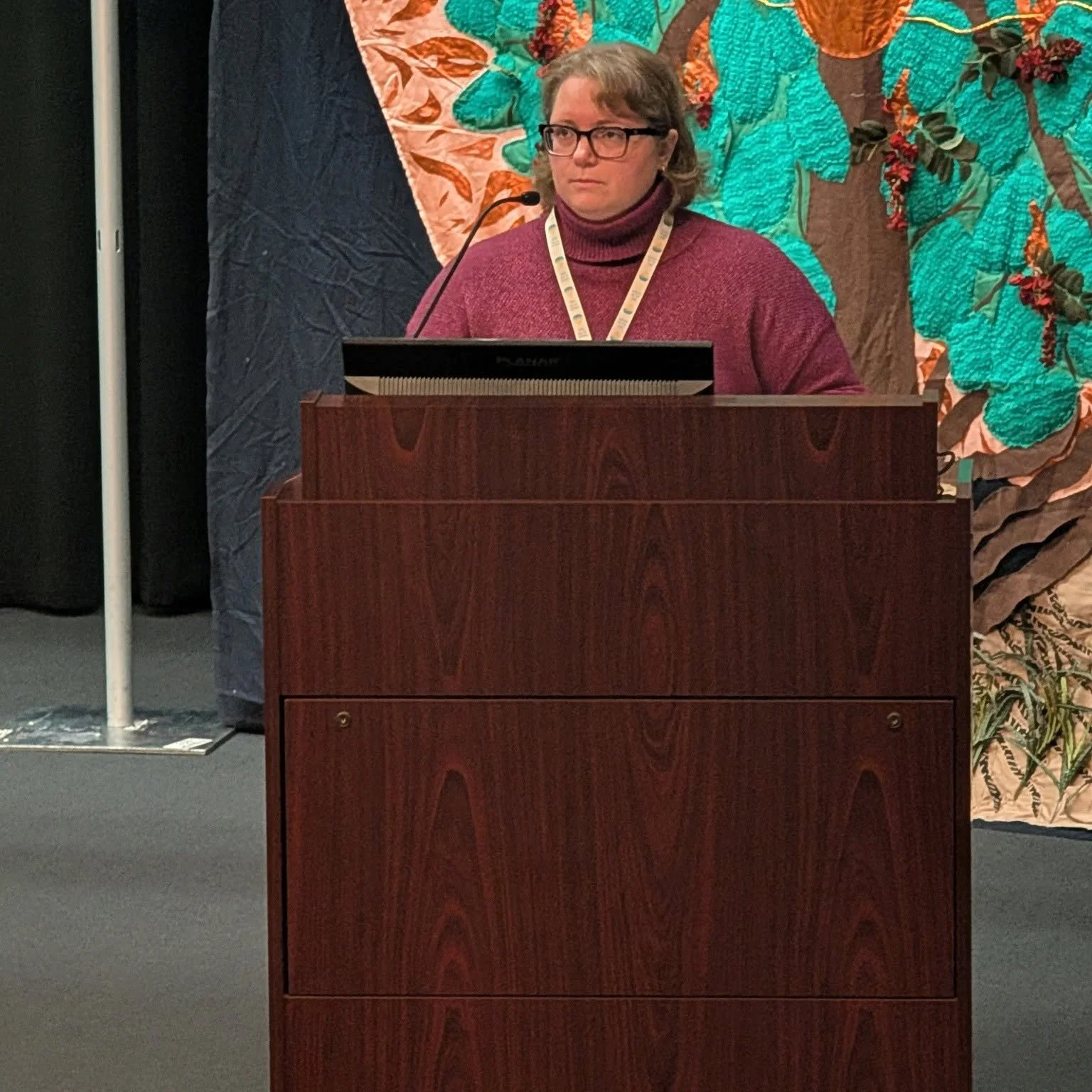
Dignity USA’s Darby DeJarnette at the CTA 50th Anniversary Conference
Reflection given by Darby DeJarnette who is the Director of Operations for Dignity USA at CTA’s 50th Anniversary Conference.
As I was praying over the reading from Jeremiah that was just shared, this line stood out to me: “Even prophets and priests wander about an unfamiliar land.” I was thinking about what it means to live your whole life in an unfamiliar land. I think many of us feel this acutely, whether is in a literal sense such as in the case of immigrants and refugees, or if it is just metaphorical. How do you learn to feel safe and familiar in your body when your race, abilities, sexual orientation or gender identity mark you as different or lesser in the eyes of the dominant culture and in the eyes of the hierarchy of your faith tradition? Even those who benefit in some ways from these dominant paradigms are in bondage to them, though they struggle to see it.
Sometimes we don’t have the strength to heal. Sometimes we have to find a way to move forward to the best of our abilities while enduring a gaping wound. Sometimes we choose or are forced to stay in that pain when we know the ending is not a happy one. We see the tangles of our own complicity in unjust social structures alongside our inability to survive our own personal faults. I’m always struck by this passage in the letter written by Father Christian de Cherge, one of the Trappist monks who was captured and killed alongside other members of his community during the Algerian civil war. He writes:
My life is not worth more than any other—not less, not more. Nor am I an innocent child. I have lived long enough to know that I, too, am an accomplice of the evil that seems to prevail in the world around us, even that which might lash out blindly at me. If the moment comes, I would hope to have the presence of mind, and the time, to ask for God’s pardon and for that of my fellowman, and, at the same time, to pardon in all sincerity he who would attack me.
Father Christian was well aware of the French colonialism that had led to violent conditions in Algeria, yet he and the Trappists chose to stay in solidarity with the Muslim community that wasn’t given the option to flee from that violence that Father Christian and his brothers would eventually become victims of.
We talk a lot in our respective communities about hope, but we’re sometimes afraid to enter into the suffering that acknowledges that things may not work out, that the injustices and evils which have been done to us and others require a forgiveness that we or they often don’t possess when the time comes to exercise it. As the prophet Jeremiah wrote: “We were hoping for peace, to no avail. For a time of healing, but in its place comes terror.”
We’re getting closer to Advent, to the time of remembering the Incarnation. This reminds us that when we tell God that we feel hopeless, that we can’t summon joy, that we are strangers to ourselves God replies: I know. I know what it’s like to be bound to a time and place where things are not fair and may not get better. I know what it’s like to be in a body that fails. I know what it’s like to want to die from grief because the only thing ahead is unavoidable su@ering. I know these things because I lived them.
This is what makes the message of Jesus so radical: each person is a unity of body and soul, and each person is made in the image and likeness of God. We are told that our bodies are unfamiliar, that the territories of our hearts and minds can’t be fathomed or traversed. We lament the pain in our souls and the pain we see in others, but God always remembers us. God remembers us when we are forgotten by our communities, our Church and ourselves. God remembers the countless people who will never be acknowledged or known, who have died in obscure circumstances, or whose only light is the constant light of despair and oppression.
What comes after the worst moments of our lives? What follows that relentless heaviness? Release and union, an all-consuming love. God extends a hand to God’s people and we reach back. The world can take everything from us: our happiness, our livelihoods, our freedom, even our lives. But God remains with us. God remembers us.
I’ll leave you with a couple more passages from Father Christian’s letter, where he meditates on his life and thanks the one who may eventually take it from him, which I hope will orient us towards the joy found in knowing we are in this together and that there is something greater, after all, to look forward to. He writes:
This life lost, totally mine, and totally theirs, I give thanks to God, who seems to have wanted it to be utterly so, for this joy, through and despite everything.
Within this thank you where, once and for all, all is said about my life, I include you, my friends of yesterday and of today, and you, my friends from here, along with my mother and my father, my sisters and my brothers and all who belong to them, life yielded a hundredfold as was promised!
And you, too, my last-minute friend, you who know not what you do.
Yes, for you, too, I wish this thank you, and this “adieu,” which is of your planning.
May we be granted to meet each other again, happy thieves, in paradise, should it please God, the Creator of both of us. Amen! Inshallah!
