
Gustavo Gutiérrez: A faith that begins at the margins
As CTA celebrates Hispanic Heritage Month, we want to take time not only to celebrate culture, but also to recognize the people, movements, and ideas from Latin America
that have helped shape the Catholic Church.
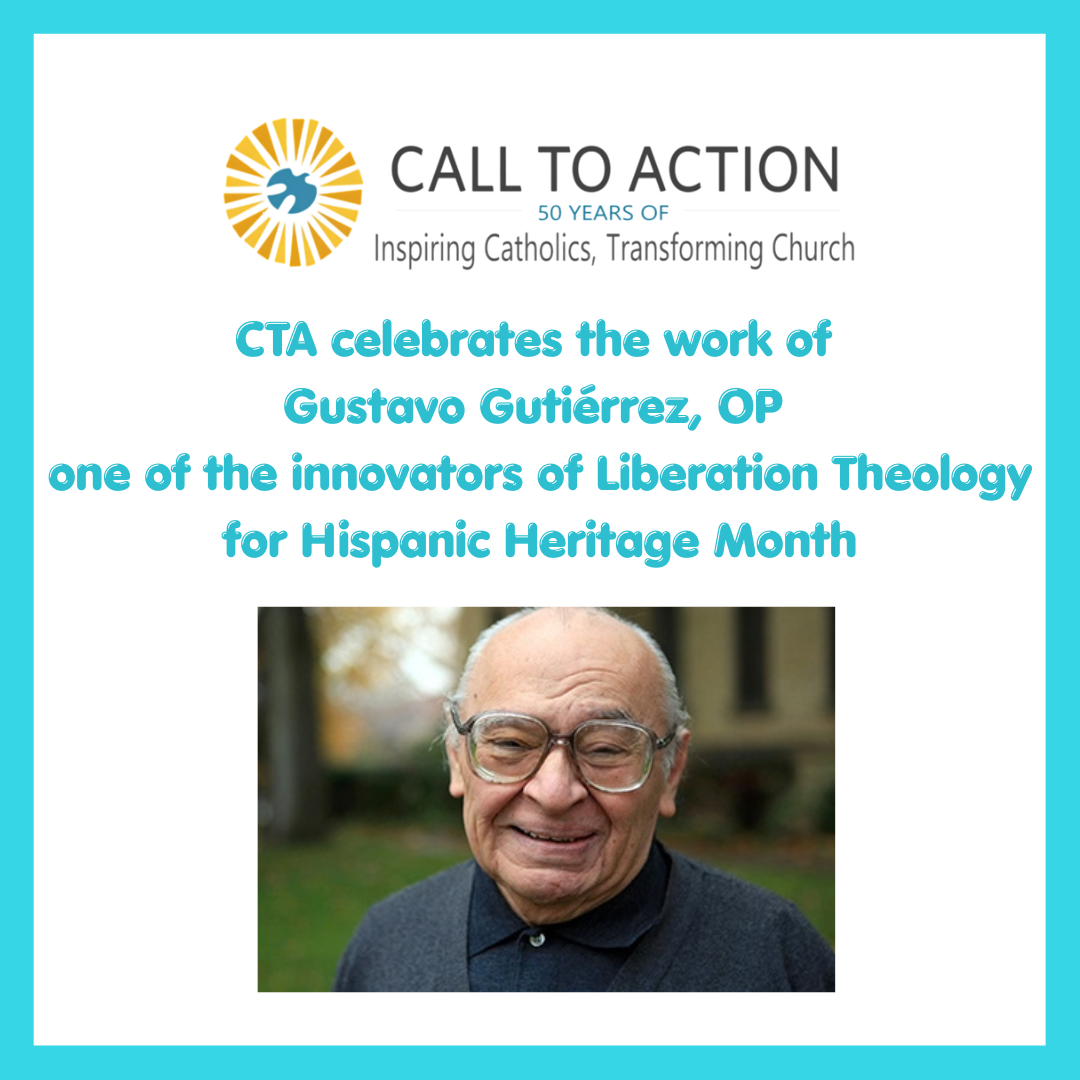
One of those people is Fr. Gustavo Gutiérrez OP, a Peruvian priest and theologian who became one of the most important voices behind what came to be known as Liberation Theology.
Gutiérrez's work grew out of the realities he saw around him in Latin America, especially widespread poverty, inequality, and communities that were often ignored by both society and the Church. He believed that faith could not be separated from those realities. For him, Catholicism was not only about caring for people after they experienced suffering, but also about asking what systems were creating that suffering in the first place. That was part of what made Liberation Theology so important. It challenged Catholics to look at the Gospel through the experiences of people living in poverty and oppression, and to ask what it really means for the Church to stand with them.
His best-known book, A Theology of Liberation, helped bring those ideas to a wider audience. It argued that faith should be connected to the struggle for human dignity and freedom from oppression. Gutiérrez also believed that people living in poverty should not be treated as passive recipients of charity. Their experiences should help shape how the Church understands justice and its responsibility to the world.
Gutiérrez's work also helped bring greater attention to what Catholics often call the preferential option for the poor. This does not mean that some people's lives matter more than others. Instead, it asks us to pay particular attention to people whose voices and dignity are most often pushed aside.
That idea continues to challenge the Catholic Church today. Who gets listened to? Who gets to make decisions? Whose experiences are treated as important? And who is expected to simply accept the way things have always been? These are questions that connect directly with the work of Call To Action.
CTA has long worked toward a Church that is more inclusive, more accountable, and more willing to listen to people who have been marginalized within Catholic spaces. That includes people affected by racism, sexism, homophobia, transphobia, exclusion from leadership, and many other forms of injustice.
For CTA, highlighting Gustavo Gutiérrez during Hispanic Heritage Month is not simply about celebrating an influential Latino Catholic figure. It is also about recognizing how Latin American Catholics have shaped the way the wider Catholic Church understands justice. Gutiérrez reminds us that communities on the margins are not simply people the Church is called to "help." A more just Church is one where those voices are not treated as an afterthought but are part of shaping the community itself.
That is also why his work remains meaningful for CTA. Our vision of reform in our Church and in our world is not only about changing rules or institutions. It is about creating a Church where people can belong fully, where their dignity is respected, and where those who have historically been excluded have real voice and power.
As we celebrate Hispanic Heritage Month, we honor Gustavo Gutiérrez as one of the many Latin American voices who pushed the Church to think more deeply about faith, justice, and solidarity.
For CTA, it is part of the work we continue to do together.
